Showing posts with label 1920'S MUSE. Show all posts

Friday, April 20, 2012

ART DECO DESIGN

While we are away at High Point Furniture Market I thought I'd share a few blasts from the past.  Enjoy, and we'll catch up when we return!
Of all the design periods in history, Art Deco had to be one of the most short lived. Born in a time of luxury and decadence, the golden age of ocean liners, cocktails and jazz bands, art deco was too soon a causality of the austerity which was ushered in by WWII.
The Hollywood take on AD usually involved mirrors, lots and lots of mirrors.

 Essentially an eclectic style, art deco emphasized modernity, the latest techniques in manufacturing, sleek streamline forms and geometric patterns, making it a design style which can easily be integrated into a contemporary home.  To my personal delight, art deco in it's simplicity, blends almost seamlessly with the mid century modern style Braxton and I love so much.
Perhaps my favorite art deco inspired room.  Black and white always work in a bathroom, don't they?

 Art Deco is essentially a blending of American and French aesthetics, thanks to the expatriated American artists and dreamers who flocked to Paris in the 1920's, a subject which obviously requires it's own post later in the week.

 The Art Deco style represented elegance, glamour, and modernity, all of which soon became unfashionable due to the drastic economic changes brought on by the collapse of the stock market in 1929.
This and the following two pictures are of a modern art deco inspired hotel bar in Florida.  I'll be in the corner sipping a Gin and Tonic and listening to the jazz band!


 The following four pictures are from the Barbara Berry Collection for Baker Furniture....just to demonstrate how a modern take on art deco, which BB does quite well, can seem fresh and modern today.


 Based on geometric shapes, art deco's inspirations were presumed to be modern aviation, electric lighting, ocean liners and sky scrapers.  Most of the train stations built in the U. S. during the 20's were fantastic art deco structures, and much of the modern architecture so famous in Chicago, is at least AD inspired, if not actually of that day.
Now that our youngest daughter has moved to Chicago for Grad school, Braxton and I can't wait to visit and take the tour.  Sarah has said that native Chicagoans (?) love to show off their knowledge of the local architecture.  Have you been to Chicago to see the famous buildings?  Please tell.

The following pictures are of art deco (or AD inspired) poster art.  I would love to do an entire post on AD art, we'll see if I have time.


As you can probably tell, I'm just a little bit excited about this weeks muse!  If you have anything to add, or anything you'd like for me to research, let me know.
Have a beautiful swell day.
YANCEY

Friday, September 30, 2011

FLAPPER STYLE

A young girl
A prostitute
A young bird flapping it's wings while learning to fly.......
according to our friends at wikkipedia, these are all legitimate definitions of the word Flapper. 
For our purposes I think I'll just go with the 1920's description of a flapper as women (or girls) who were viewed as attractive, reckless and independent....or fun!
 As with any good thing, there were of course detractors.  The writer/critic Dorothy Parker penned "Flappers: A Hate Song", and a Harvard psychologist of the day wrote that "flappers have the lowest degree of intelligence".  Basically, flappers posed a significant challenge to traditional Victorian morals.
FLAPPER SLANG:  "SNUGGLE PUP" - A MAN WHO FREQUENTS  PETTING PARTIES(Oh God, that's hysterical)
Flappers were known for their "shocking behavior" (at least in the eyes of the previous generation), they danced provocatively, smoked cigarettes from long holders (remember, few women of the previous decade smoked at all, and those who did certainly would never have smoked in public), drove cars, dated freely and drank openly.

FLAPPER SLANG:  "BARNEY-MUGGING" - SEX 
(Tell me I'm not the only one confused by this)
 Flapper fashion was heavily influenced by French fashion, particularly by the designer Coco Chanel...If you're interested in Chanel, I highly recommend the movie Coco, Before Chanel, it's a look into her early life and inspirations before she became famous.
Hallmarks of the flapper style were;  a young and boyish figure (large breasts were thought to be a sign of unsophistication) short hair, straight waists (the Victorian tradition of using corsets to make the waist smaller was dead), bare arms, nude stockings (previous generations wore heavy black stockings), and dresses had dropped waists to the hips.
As seen in the photos, flappers loved their jewelry...they wore long beaded necklaces, earrings and rings were art deco in design, and the brooch was very popular.

FLAPPER SLANG:  "I HAVE TO SEE A MAN ABOUT A DOG" - GOING TO BUY WHISKEY
 And now, just because I found these, Kate Moss in a flapper(ish) dress, and Isabella Rossellini in full retro 20's hair and makeup.
 FLAPPER SLANG:  "HANDCUFF" OR "MANACLE" - AN ENGAGEMENT OR WEDDING RING
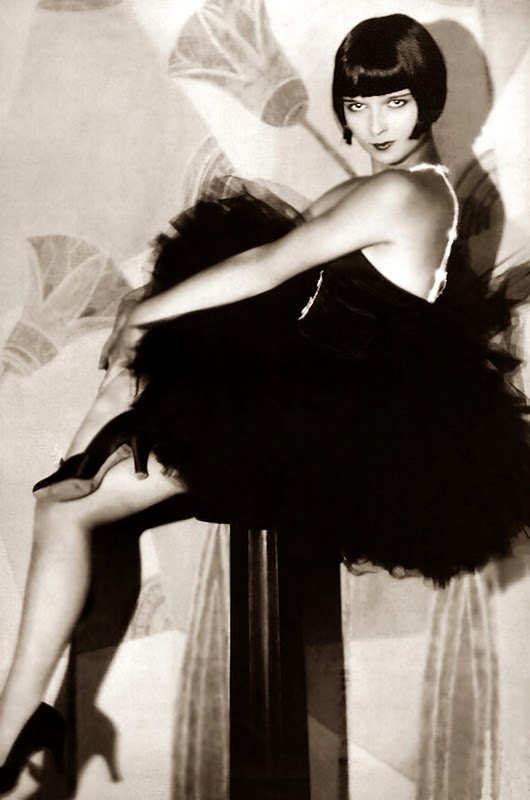
The first photograph in this post is of the American actress Louise Brooks.  I intentionally left her out of my "Goddesses of the Silver Screen" post, because I thought she deserved more space.  In my opinion she was the most  beautiful of all the "goddesses".  I see her as a cross between Audry Hepburn and Leslie Caron....sweet, sexy and wise.

FLAPPER SLANG:  "CATS MEOW" OR "CATS PAJAMAS" - SOMETHING WONDERFUL


 FLAPPER SLANG:  "HOOCH" - LIQUOR


This looks like it could have been taken in the 60's.


So beautiful.


 And there it is, the end of a wonderful muse week.  I've literally dreamt about the 1920's this week.  I (re)read The Great Gatsby and Braxton and I saw the movie for the first time.  This week had definitely been the cats meow.
Have a beautiful weekend everyone!  You guys really are the bees knees.
YANCEY

Thursday, September 29, 2011

PARIS IN THE 1920'S AND THE AMERICANS WHO FLOCKED THERE

 Ernest Hemingway, Man Ray, Picasso, F. Scott Fitzgerald, T. S. Elliot, Dali, Cole Porter, Gertrude Stein.  Why did so many of Americas best and brightest spend the better part of the 20's (and in some cases the better part of their lives) in Paris?  For some, the answer is simply because they could, but for others......  let's explore further...
After the war, many previously healthy and hopeful young men, returned home emotionally or physically changed, with little faith in their Government or hope for the future.
In America the KKK was at the height of it's power, violence was rampant due in part to organized crime thanks to prohibition, and we had a new found hunger for materialism, all of which added to the cynicism of the youth.
In Paris, rents were low, drinking was allowed, women were considered (somewhat) equal, and the art scene was welcoming.  Once a few restless artists and writers made a home there (and in many cases wrote about it) it seemed everyone who could, found their way to the art collector and writer Gertrude Stein's house in Paris.

Ernest and Hadley Hemingway in Paris
" All of you young people who served in the war...you are all a lost generation."  Gertrude Stein 

M/M F. Scott Fitzgerald

 The lost generation referred to young people who came back from WWI cynical about the future.  Many were American artists who moved to Paris and wrote about their disdain for American materialism.
Gertrude Stein (left) and her life partner Alice
 "America is my country, Paris is my home town"  Gertrude Stein
 Flappers epitomized the "lost generation".  Paris, as always, was the center of the fashion world.  The flapper style reflected women's changing role in society, which was becoming more active, involved, and equal.
"Flappers loved to flirt, bob their hair, put on their choicest pair of earrings, and a great deal of audacity and rouge, and go into battle."  Zelda Fitzgerald

Picasso's art studio in Paris
 1924 was "the summer of a thousand parties."  F. S. Fitzgerald
Gertrude Stein's house in Paris
 "Paris was always worth it"  Hemingway
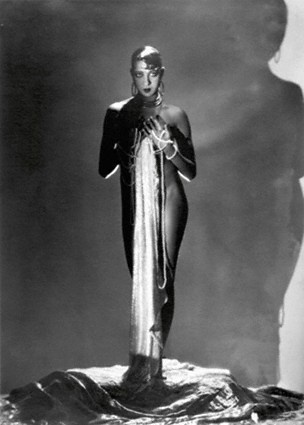
 One cannot discuss Paris during the 1920's without including the singer and erotic dancer Josephine Baker.  "La Baker" was an African American, probably of mixed race, who left America for Paris after encountering racism and censorship.  By comparison, the jazz age in Paris was exotic, sensual and inviting for African American entertainers.
Hemingway, Gertrude Stein and Picasso were all fans of Josephine Baker.
Due to the rampant racism and the powerful presence of the KKK, Josephine Baker renounced her American citizenship and eventually married a Frenchman and became a french citizen.


 "Surely the day will come when color means nothing more than the skin tone, when religion is seen uniquely as a way to speak one's soul; when birth places have the weight of a throw of the dice and all men are born free, when understanding breeds love and brotherhood."  Josephine Baker
Amen sister.
Have a beautiful day.
YANCEY
Related Posts Plugin for WordPress, Blogger...